Does the traditional discipline model work?
In the current model, when a child is naughty, parents scream and shout, and often give hidings. We find a similar situation in the workplace. When an employee makes a mistake, often bosses don’t allow them to apologize or share their side of the story; instead, they reprimand, warn, and then dismiss. Does this change the behaviour?
I was watching some of Eddie Murphy’s early comedy. He does this bit where he’s talking about his mom: she would throw a shoe at him at the drop of a dime. She was bad with a shoe. She carried it around like a gun. By the time Eddie was 10 or 11, she was like Clint Eastwood with a shoe. If he messed up, his mother would walk into the room and… BAM! Shoe to the face!
Growing up, it seems Eddie’s house was very strict. Yet, for all those beatings, for all that violence, he made a living standing on stage saying, “F this; suck my that; stick my this up your that…” So did it change the behaviour?
Originally, I wrote this article as one of my talks for Toastmasters. (For those who don’t know, Toastmasters is an international organization, with the goal of helping people learn to be better public speakers and leaders.) This article is adapted from one of my talks, which was inspired by a talk from another member the month before. We were rolling on the floor, as he regaled us with tales of his childhood and the various misdemeanours he and his siblings would commit. After each one, they received their scolding and beating. And guess what: they did it again… and again! So did it change the behaviour? Who doesn’t have a childhood story similar to that…
The current model teaches children the very violent manner in which our society communicates. Often, people demand instead of asking. Some take when they don’t get what they want. It teaches children that, “if you hit me, I must hit you harder.”
It is a very oppressive way of disciplining. We oppress children’s ability:
-
to make mistakes,
-
to allow them to say sorry for things that often, many of us do or have done;
-
most importantly, we oppress people’s ability to express themselves.
However, when society oppresses groups of people, eventually those groups rise up and take back what is theirs. In doing so, much blood, and many tears are shed, countless lives are destroyed, and suffering is felt on an immeasurable scale.
Isn’t this similar to what happens in homes all over the world… A child makes a mistake, which ends up with parents and child screaming at one another:
-
the violence burns through fists,
-
hatred dissolves into each other’s minds, where it festers like cancer,
-
grudges are held,
-
resentments are built,
-
and as we often are seeing, the family bond is withering away;
-
and most importantly, the behaviour rarely changes…
This is the result of the current model … and society calls it discipline.
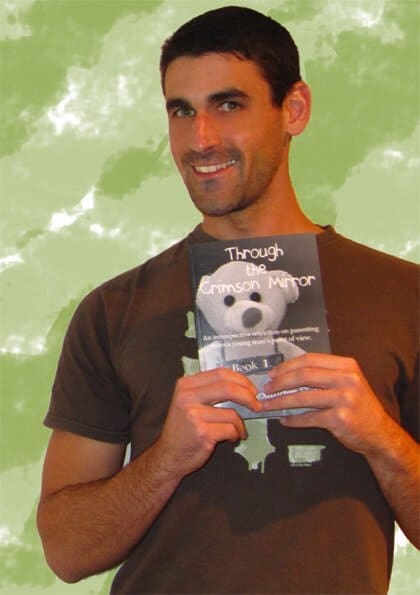
I wrote a book about my experiences growing up called Through the Crimson Mirror. While writing, I interviewed a range of people: from teachers to physiologists, children to speech therapists, and reformed alcoholics. What I found is that alcoholics and others, who have what society perceives as anti-social disorders, act the way they do because of something deeper. Usually, it’s extreme-pain or a feeling of being alone or unloved.
So what do we often do, when we interact with these people? We tell them:
-
you aren’t good enough,
-
you aren’t worthy,
-
you’re a bad person,
-
you’re nothing more than an alcoholic…
To fix them, to make them feel less lonely, we cast them out… So what’s really causing them to continue drinking? I’m not saying there wasn’t an initial problem that was the catalyst for their behaviour. Nor am I condoning the way they act. However, we validate what they do by perpetuating their ridicule.
Recently in South Africa, Para Olympian superstar Oscar Pistorius, shot and killed his girlfriend Reeva Steenkamp. The investigation is still pending, so we don’t know conclusively what happened on that night. Nevertheless, many people have mocked and vilified him. The media have slandered him. People throughout the world hate him now, with a burning passion! He has pretty much been made a prisoner in his family’s home.
Following that, a few weeks ago, I heard on the radio that he was spotted out drinking and partying. Really, people are surprised that now, our fallen hero, who we’ve turned our back on, has sought refuge in drinking to stop the demons in his mind…
So, what is the answer: in my opinion, its communication. Communication leads to understanding, and understanding leads to change. When someone acts out or does something that we perceive as naughty, there is usually a reason why. If no one communicates with them and attempts to dig deeper into why they did what they did, there is little chance for change. There is a reason for everything and everything for a reason…
For human beings, there is something magical about expressing yourself. I’ll use the example of joining Toastmasters and learning to become a public speaker. Hundreds of thousands of people all over the world spend time writing speeches and preparing. We fight the nerves, the potential for embarrassment, for what? What do we get out of standing in front of a crowd and talking? We have the opportunity to have others listen to us. Behaviour changes, when people feel heard.
Oppressive, torturous discipline has proved itself ineffective; let’s rather give people an opportunity to communicate and express themselves…
Furthermore, how we treat people such as Oscar and those with anti-social disorders continues to demonstrate how sometimes, it’s our solutions, which are causing so-called problems.
So, in the same vein, do we have to discipline children because they do naughty things; or do children do things that society perceives as naughty, because as a society, we are willing to psychologically and physically torture them, for making mistakes, experiencing life, and not doing things the way we expect them to…?
Through the Crimson Mirror on Kindle: http://www.amazon.com/dp/B00904HFTQ
Beginners Success in Public Speaking on Kindle: http://www.amazon.com/dp/B00A4UF06A
Beginners Success in Public Speaking in print https://www.createspace.com/4326431 (will be available on Amazon in a week)
Web: http://daniel-alexander-book.blogspot.com/
Facebook: www.facebook.com/daniel.alexander.book
Twitter: https://twitter.com/#!/danielalex_book
Blog: http://daniel-alexander-book.blogspot.com/


Never miss a new post!
Don’t forget to tailor your preferences, so you just get the posts you want to read!
Follow Motherhood Diaries on Facebook (Facebook Recipes Page), Twitter, Pinterest, Instagram, Google+ and LinkedIn
If you’d like to share your pregnancy or parenting story, then please do share your story here. Don’t forget to read our Ad Policy